Day of the Dead (Día de Muertos): Origins, Ofrendas and La Catrina
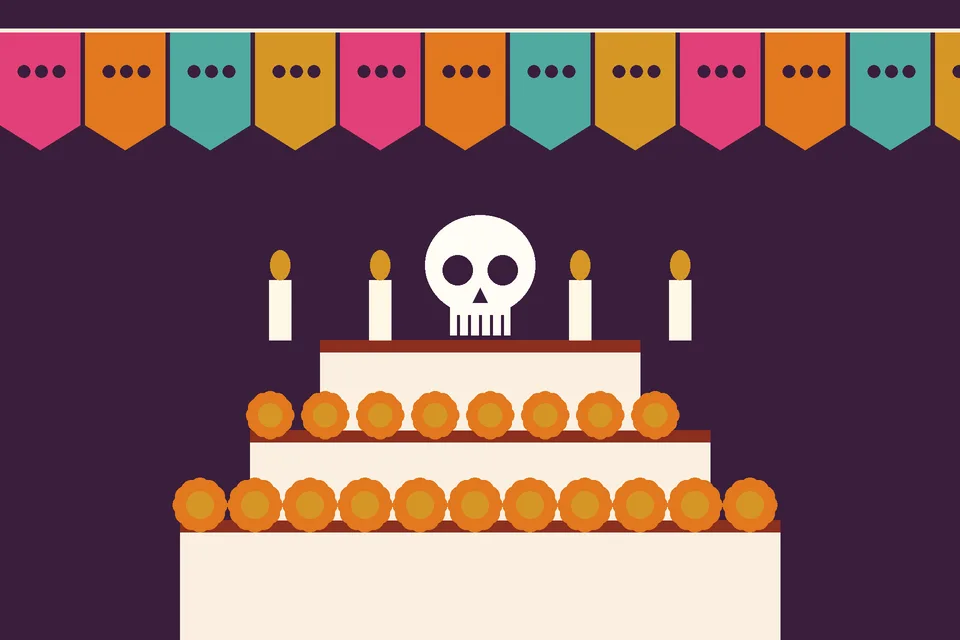
The Day of the Dead, Día de Muertos, is a Mexican celebration held mainly on 1 and 2 November, when families welcome back the souls of their dead relatives with home altars, flowers, food and visits to the cemetery. It falls just after Halloween and shares some of its imagery, skulls above all, but its spirit is different: it is a family reunion with the dead rather than a night of fright. UNESCO lists it as part of the Intangible Cultural Heritage of Humanity.
When it is celebrated
The dates match the Catholic feasts of All Saints' Day (1 November) and All Souls' Day (2 November). In many communities the first day is set aside for children who have died, often called angelitos ("little angels"), and the second for adults. Preparations start earlier: markets fill with marigolds and sugar skulls in the last days of October, and in some regions the welcome for particular groups of the dead begins before 1 November. Practices vary a great deal from one state, town and family to the next, so any description of "the" Day of the Dead is a generalisation.
Where it comes from
Historians describe the festival as a blend. On one side are the Catholic feasts brought by the Spanish in the 16th century; on the other, the rites with which Indigenous peoples of Mexico honoured their dead long before the conquest. Spanish chroniclers, notably the friar Bernardino de Sahagún, recorded that the Mexica (Aztecs) held festivals for the dead in months of their calendar that fell around the middle of the year. Over the colonial centuries, offerings to the dead were folded into the Christian calendar of early November, keeping practices such as gifts of food and flowers.
The same two feasts lie behind Halloween. As our page on how Halloween started explains, All Saints and All Souls shaped customs such as "souling", in which people went from door to door in parts of Britain receiving soul cakes in return for prayers for the dead. A shared Christian date thus produced two very different festivals on either side of the Atlantic.
In 2003 UNESCO proclaimed the "Indigenous festivity dedicated to the dead" in Mexico a Masterpiece of the Oral and Intangible Heritage of Humanity, and in 2008 it was inscribed on the Representative List of the Intangible Cultural Heritage of Humanity.
What goes on an ofrenda
At the heart of the celebration is the ofrenda, an offering arranged on a table or tiered altar in the home, and sometimes in schools, offices and public squares. There is no single fixed design, but the common elements include:
- Photographs of the people being remembered, and sometimes their personal belongings.
- Cempasúchil (Mexican marigold, Tagetes erecta), whose orange colour and strong scent are said to guide the souls home; petals are sometimes scattered in a path to the altar.
- Candles to light the way, and copal, a tree resin burned as incense.
- Water for souls thirsty after their journey, and often salt.
- Food and drink the dead person enjoyed, from tamales and mole to fruit, chocolate, a favourite beer or tequila.
- Pan de muerto, a sweet bread decorated with strips of dough shaped like bones.
- Calaveras de azúcar, sugar skulls, often with a name written across the forehead.
- Papel picado, tissue paper cut into lace-like patterns and strung in banners.
The idea is that the souls take in the essence of the food; afterwards, the living share what is left. In many towns families also clean and decorate graves and spend the night in the cemetery with candles, food and music. The island of Janitzio, in Lake Pátzcuaro in the state of Michoacán, is one of the best-known places for these vigils.
Skulls, verses and La Catrina
Skulls, calaveras, are everywhere: in sugar, in clay, in face paint. The skull is a fitting symbol, since it is the most recognisable part of the skeleton; as our page on the bones of the body notes, it is made of 22 bones fused into one protective case. The word also names a literary form: calaveras literarias are short, mocking verses written as mock epitaphs for living people, including politicians, which newspapers and schools publish around 2 November.
The most famous skull of all is a woman's. Around 1910–1913 the printmaker José Guadalupe Posada made a zinc etching of a skeleton in an elaborate European-style hat, which he called La Calavera Garbancera. It mocked Mexicans who imitated European fashions and denied their Indigenous roots. In 1947 the painter Diego Rivera placed her, full-length and in an elegant dress, at the centre of his mural Dream of a Sunday Afternoon in the Alameda Central, beside a portrait of Posada himself, and she became known as La Catrina, from catrín, a well-dressed dandy. Today she is the festival's best-known figure.
Not "Mexican Halloween"
Because the dates are so close, the two are often confused. The differences are of tone and purpose. Halloween in its modern form centres on costumes, trick-or-treating and playful fear; the Day of the Dead centres on remembering particular people, inviting them back and keeping their memory alive in the family. Costumes and face painting have become part of public celebrations in Mexican cities, and Halloween customs have also spread in Mexico, so in practice the two now meet. Gestures and symbols can change meaning between cultures, as our guide to hand gestures around the world shows, and a painted skull is a good example: frightening in one tradition, affectionate in the other.
When a film created a tradition
Mexico City's large Day of the Dead parade is recent. The opening sequence of the James Bond film Spectre (2015) showed an invented parade with giant skeletons in the city's historic centre. After the film's release, the city government organised a real one in 2016, and it has been held most years since, drawing large crowds. Pixar's animated film Coco (2017), set during the festival, further spread its imagery around the world.
Quick quiz: Day of the Dead
Sources
- UNESCO Intangible Cultural Heritage, Indigenous festivity dedicated to the dead (inscribed 2008).
- Brandes, S. (2006). Skulls to the Living, Bread to the Dead: The Day of the Dead in Mexico and Beyond. Blackwell.
- Encyclopaedia Britannica, Day of the Dead (consulted October 2026).
- Wikipedia, La Calavera Catrina and Day of the Dead (consulted October 2026).
 People & Customs
How did Halloween start?
Samhain, All Hallows' Eve, guising and turnip lanterns: where the holiday comes from.
 Human Body
Bones of the body
Why adults have 206 bones and babies more, and how they split across the skeleton.
 People & Customs
Hand gestures around the world
Thumbs up, OK, the V sign and nodding: same sign, different meaning.