Bones of the Body: How the 206 Bones of the Skeleton Add Up
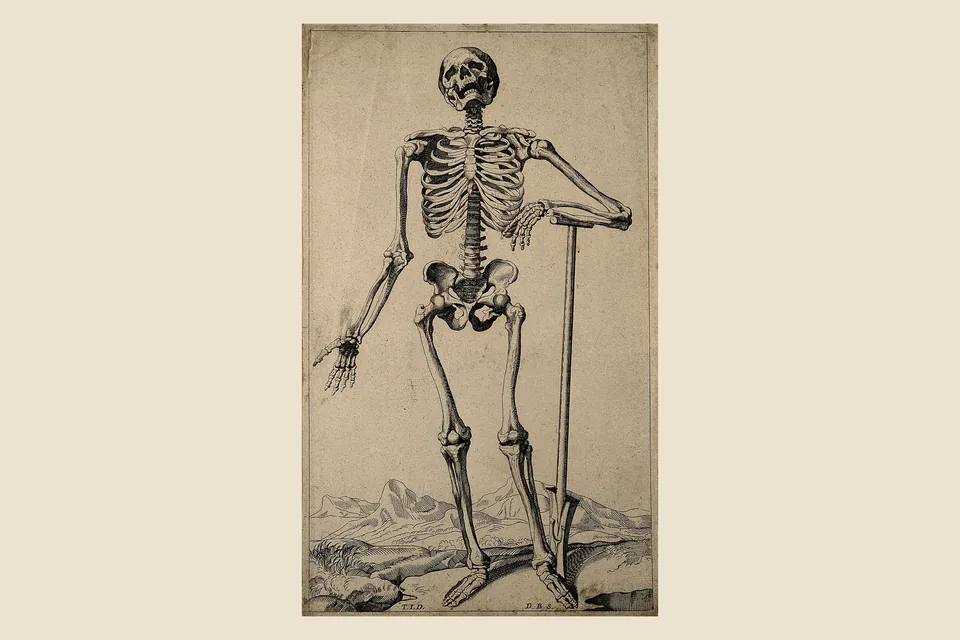
A typical adult skeleton has 206 bones: 80 in the axial skeleton (skull, spine, ribs and breastbone) and 126 in the appendicular skeleton (shoulders, arms, hips and legs). A newborn has more separate bony pieces, often quoted as around 270–300, which fuse as the child grows.
Why the number changes with age
Bones begin as cartilage or membrane and ossify (turn to bone) from several centres. At birth, many bones still consist of separate pieces joined by cartilage: the skull is made of plates separated by soft gaps (the fontanelles), the sacrum is five vertebrae, and long bones have separate ends (epiphyses) attached by growth plates. Over childhood and adolescence these pieces fuse; the last growth plates typically close in the early to mid-twenties. The figure of 206 is also an average convention: some people have an extra rib, extra small bones in the hands and feet (sesamoids beyond the kneecaps) or tiny extra bones in the skull sutures.
How the 206 add up
| Region | Bones | Details |
|---|---|---|
| Skull | 22 | 8 cranial bones enclosing the brain, 14 facial bones |
| Middle ears | 6 | malleus, incus and stapes on each side |
| Hyoid | 1 | U-shaped bone in the neck, supporting the tongue |
| Vertebral column | 26 | 7 cervical, 12 thoracic, 5 lumbar vertebrae, plus the sacrum and coccyx |
| Ribs | 24 | 12 pairs |
| Sternum | 1 | the breastbone |
| Axial skeleton | 80 | |
| Shoulder girdles | 4 | a clavicle and a scapula on each side |
| Arms and hands | 60 | per side: humerus, radius, ulna, 8 carpals, 5 metacarpals, 14 phalanges |
| Hip bones | 2 | each formed by the fusion of ilium, ischium and pubis |
| Legs and feet | 60 | per side: femur, patella, tibia, fibula, 7 tarsals, 5 metatarsals, 14 phalanges |
| Appendicular skeleton | 126 |
The hands and feet alone account for 106 bones (27 in each hand and 26 in each foot), more than half the skeleton.
Records and curiosities
- Longest and strongest: the femur (thigh bone). Its length is roughly a quarter of a person's height, a relationship forensic anthropologists use to estimate stature from skeletal remains.
- Smallest: the stapes, or stirrup, in the middle ear, about 3 mm long. Together with the malleus (hammer) and incus (anvil), it transmits vibrations from the eardrum to the inner ear.
- The loner: the hyoid is the only bone that does not form a joint with any other bone. It is held in place by muscles and ligaments.
- True, false and floating ribs: the first seven pairs attach directly to the sternum ("true" ribs); pairs 8 to 10 attach indirectly through cartilage ("false" ribs); pairs 11 and 12 have no front attachment ("floating" ribs). Men and women have the same number of ribs.
- The tailbone: the coccyx is formed of three to five small fused vertebrae, which is one reason bone counts vary slightly between people.
The hand: 27 bones of precision
Each hand has 8 small carpal bones in the wrist, arranged in two rows (scaphoid, lunate, triquetrum and pisiform; trapezium, trapezoid, capitate and hamate), 5 metacarpals in the palm, and 14 phalanges in the fingers: three in each finger and two in the thumb. The scaphoid is the most commonly fractured carpal bone, typically after a fall on an outstretched hand, and because its blood supply is limited it can be slow to heal. The joint at the base of the thumb, between the trapezium and the first metacarpal, is a saddle joint, which allows the thumb to swing across the palm and makes precise grips possible.
What bones do
- Support and movement: bones form levers for muscles; joints between them determine the range of movement.
- Protection: the skull protects the brain, the vertebrae the spinal cord, and the rib cage the heart and lungs.
- Blood cell production: red bone marrow makes red blood cells, white blood cells and platelets. In adults it is found mainly in flat bones such as the hip bones, sternum, ribs, vertebrae and skull.
- Mineral storage: bone holds about 99% of the body's calcium and much of its phosphate, releasing them into the blood when needed.
Bone is living tissue that is constantly remodelled: cells called osteoclasts break down old bone while osteoblasts build new bone. Weight-bearing exercise stimulates bone formation; prolonged inactivity, and the weightlessness experienced by astronauts, causes bone loss.
Quick quiz: the skeleton
Sources
- National Cancer Institute, SEER Training Modules, Skeletal System (divisions of the skeleton, functions of bone).
- OpenStax, Anatomy and Physiology 2e, chapters 6–8 (bone tissue, axial and appendicular skeleton).
 Human Body
The central nervous system
Brain and spinal cord: how they are built, protected and wired, with the numbers worth knowing.
 People & Customs
Hand gestures around the world
Thumbs up, OK, the V sign and nodding: same sign, different meaning.
 Nature
Hairless dog breeds
Xolo, Chinese Crested, Peruvian and American Hairless, and the genetics behind bare skin.