How the Kidneys Work: Nephrons, Filtering and the Hormones Few People Know About
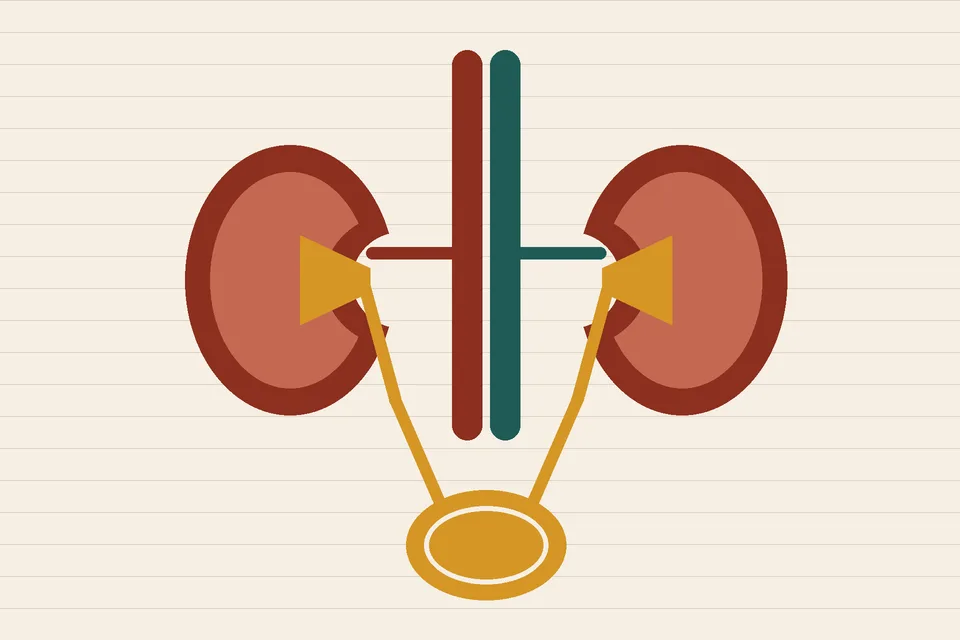
Most people could point to their heart and their lungs, but the kidneys are harder to place, and their job is often summed up as "making urine". That is the visible result of something far more delicate. Your blood passes through two organs the size of a fist many times a day, and they strain out almost everything small enough to fit through their filters and then carefully take back nearly all of it. What they leave behind is what you get rid of.
Where they are, and what they look like
According to the US National Institute of Diabetes and Digestive and Kidney Diseases (NIDDK), the kidneys are two bean-shaped organs, each about the size of a fist, located just below the rib cage, one on each side of the spine. They sit towards the back of the abdomen rather than the front, which is why kidney pain is usually felt in the back or side. The right kidney normally sits a little lower than the left, pushed down by the liver above it.
The curved inner edge of each "bean" faces the spine. This notch, the hilum, is where the plumbing connects: the renal artery brings blood in, the renal vein takes it out, and a thin muscular tube, the ureter, leaves for the bladder. Cut a kidney in half lengthways and you see an outer layer, the cortex, a darker inner zone, the medulla, arranged in cone-shaped pyramids, and a funnel-shaped space, the renal pelvis, where urine collects before it drains into the ureter.
A million tiny filters in each kidney
The working unit of the kidney is the nephron, and the NIDDK puts their number at about a million in each kidney. Every nephron has two parts, and they do two opposite things.
The first part is the glomerulus, a tight knot of very small blood vessels. Their walls are thin enough to let water, salts, sugar and waste products such as urea pass through, while larger things, like blood cells and most proteins, stay in the blood. The fluid squeezed out is caught by a cup-shaped capsule around the knot. The structure is named after the English surgeon William Bowman, who described it in 1842, building on observations made under the microscope by the Italian anatomist Marcello Malpighi almost two centuries earlier.
The second part is the tubule, a long, folded tube leading away from the capsule. One section dips deep into the medulla and back again in a hairpin turn, the loop of Henle, named after the German anatomist Jakob Henle. Blood vessels run alongside the whole tubule, and as the filtered fluid moves along it, the body takes back what it needs.
Filter everything, then take most of it back
This is the clever part. Rather than picking out the waste, the kidney filters almost everything small, then reclaims what is useful. The numbers show how lopsided the trade is. The NIDDK says your kidneys filter about 150 quarts of blood a day, roughly 140 litres, yet only 1 to 2 quarts, about one or two litres, become urine. The rest, including nearly all of the water, sugar and many of the salts, is returned to the blood through the walls of the tubules.
Why work this way? Because it lets the body adjust its chemistry minute by minute. The tubules decide how much sodium, potassium, calcium and phosphorus to keep or let go, and they also remove excess acid produced by the body's cells. Without that balance, the NIDDK notes, nerves, muscles and other tissues may not work normally. The amount of water kept is under hormonal control too: when you are short of water, a hormone released from the base of the brain, antidiuretic hormone, tells the kidneys to hold on to more of it, and your urine becomes darker and more concentrated.
The finished urine runs from the collecting ducts into the renal pelvis, down each ureter, pushed along by waves of muscle contraction, and into the bladder, which stores it until it is emptied through the urethra.
The kidneys' second job: making hormones
Filtering is only half of what the kidneys do. They are also glands. The NIDDK lists three areas where hormones from the kidneys play a part: controlling blood pressure, making red blood cells and keeping bones strong.
- Blood pressure. When the kidneys sense that blood flow is falling, they release an enzyme called renin, which sets off a chain of reactions that narrows blood vessels and makes the body retain salt and water. Several common blood pressure medicines work by interrupting that chain.
- Red blood cells. When the blood carries too little oxygen, the kidneys release erythropoietin, often shortened to EPO, which tells the bone marrow to make more red blood cells. That is why people with failing kidneys often become anaemic, and why EPO later became notorious as a doping product in endurance sport.
- Bones. Vitamin D from sunlight or food is not active straight away. The kidneys carry out the final step that turns it into its active form, which helps the gut absorb calcium.
The kidneys also depend on the rest of the body. They need a steady flow of blood from the heart, and much of the waste they remove comes from processing what is absorbed in the digestive system: urea, for instance, is made in the liver when the body breaks down protein.
A washing-machine drum and a pair of twins
For most of history, kidney failure was a death sentence. Two twentieth-century breakthroughs changed that. During the Second World War, the Dutch doctor Willem Kolff, working in the small town of Kampen in the occupied Netherlands, built an artificial kidney from improvised materials, including sausage casing as a filtering membrane wrapped around a rotating drum. Blood passed through the casing while waste diffused out into a bath of fluid. Most of his early patients died, but in 1945 a woman in kidney failure survived after treatment, and dialysis became a practical treatment in the decades that followed.
The second breakthrough came in Boston in December 1954, when a team led by the surgeon Joseph Murray transplanted a kidney from Ronald Herrick into his identical twin brother, Richard. Because the twins were genetically identical, Richard's immune system did not reject the organ, and it worked. It was the first lastingly successful organ transplant, and it showed that the operation itself was possible; drugs to control rejection between unrelated people came later. Murray shared the 1990 Nobel Prize in Physiology or Medicine with E. Donnall Thomas "for their discoveries concerning organ and cell transplantation in the treatment of human disease". The same story also shows something reassuring: Ronald lived on with a single kidney, which can take over most of the work of two.
Quick quiz: how the kidneys work
Sources
- National Institute of Diabetes and Digestive and Kidney Diseases (NIDDK). Your Kidneys & How They Work, at niddk.nih.gov, consulted 12 November 2026.
- The Nobel Prize in Physiology or Medicine 1990 (Joseph E. Murray and E. Donnall Thomas), official summary at nobelprize.org.
- Bowman, W. (1842). On the structure and use of the Malpighian bodies of the kidney. Philosophical Transactions of the Royal Society of London, 132, 57–80.
 Human Body
How the heart works
Four chambers, four valves, two circuits and the electrical spark behind every beat.
 Human Body
How digestion works
One long muscular tube, three helper organs, and the 2014 study that shrank the gut from a tennis court to half a badminton court.
 Human Body
How the lungs work
Two lungs, five lobes, hundreds of millions of air sacs, and the dome of muscle that fills them.