How the Liver Works: Two Blood Supplies, a Litre of Bile and an Organ That Grows Back
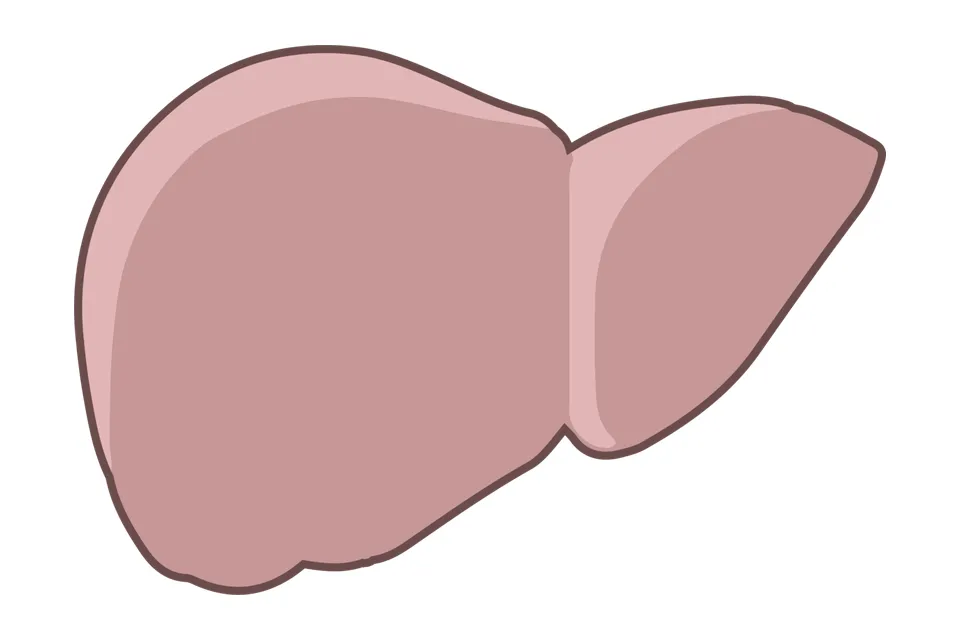
Ask people what the liver does and the usual answer is "it deals with alcohol". That is true, but it is a small part of the job. The liver sits between your gut and the rest of your body, and almost everything you absorb from a meal passes through it first. It decides what to store, what to send on, what to rebuild into something else and what to get rid of, and it keeps doing this through the night while you are not eating at all.
Where it is and what it looks like
The liver is the largest internal organ in the body, as the Merck Manual puts it, and a wedge-shaped one. According to InformedHealth.org, the patient information service of Germany's Institute for Quality and Efficiency in Health Care (IQWiG), the adult liver weighs about 1.4 kilograms (3.1 pounds) and lies in the upper right of the abdomen, just below the diaphragm. It fills most of the space under the right ribs and reaches across into the upper left of the abdomen too, which is why the ribs protect much of it.
Seen from the front, there is a large right lobe and a smaller left lobe, separated by a band of connective tissue that also anchors the liver in place. Tucked into a hollow on the underside is the gallbladder, a small pouch that stores bile. Surgeons go further: in 1957 the French surgeon and anatomist Claude Couinaud described a division of the liver into eight segments, each with its own blood supply and bile drainage. That map is still used today, because it shows where a surgeon can cut without starving the rest of the organ.
Two blood supplies, one from the gut
Most organs receive their blood from arteries that branch off from the heart's output. The liver is different. As the Merck Manual explains, it receives blood from the heart, through the hepatic artery, like every other organ, but also directly from the intestines, through the portal vein. The blood in the portal vein contains nearly everything the gut has just absorbed: sugars, amino acids, fats, vitamins, medicines, and sometimes toxins. Most of the liver's blood arrives by this route, while the hepatic artery brings oxygen-rich blood that the liver tissue and its bile ducts need.
Inside the liver, the two streams mix in a latticework of tiny channels lined with liver cells, called hepatocytes, and then leave together through the hepatic veins, heading back to the heart. This arrangement means that the liver gets first look at a meal before it reaches the rest of the body. It is also why some medicines swallowed as tablets lose part of their strength before they ever reach the general circulation: the liver has already broken some of them down on the first pass.
Lobules: the liver's working units
Liver tissue is built from many small units called lobules, which InformedHealth.org describes as clusters of liver cells with channels carrying blood and bile running between them. Under a microscope, a classic lobule looks roughly hexagonal, with a small vein at its centre and plates of hepatocytes radiating out like the spokes of a wheel. Blood flows inwards along the plates, from the edges towards the central vein, while bile made by the same cells flows the opposite way, outwards into small ducts.
The channels between the plates are also patrolled by specialised immune cells, Kupffer cells, named after the German anatomist Karl Wilhelm von Kupffer, who described them in the nineteenth century. They capture bacteria and debris arriving from the gut, and help clear worn-out red blood cells.
What the liver does with a meal
Almost every part of the body's chemistry passes through the liver at some point. A few of its jobs stand out.
- Sugar. After a meal, when blood sugar rises, the liver takes sugar out of the portal blood and stores it as glycogen. When the level falls, for example overnight, it breaks the glycogen down and releases sugar back into the blood. InformedHealth.org describes this as keeping blood glucose constant.
- Fat and bile. Liver cells produce about 800 to 1,000 millilitres of bile a day, according to InformedHealth.org. Bile is collected in small ducts, stored in the gallbladder and released into the first part of the small intestine, where it helps break down and absorb fats. The Merck Manual adds that the liver makes about half of the body's cholesterol, the rest coming from food, and that most of what it makes goes into bile. We followed the bile's route in our page on how digestion works.
- Protein. The liver converts amino acids so they can be used for energy or turned into sugar and fat. That process produces ammonia, which is toxic. The liver turns it into urea, a much less harmful substance, which travels in the blood to the kidneys and leaves the body in urine.
- Making proteins. The liver builds albumin, the protein that helps hold fluid inside blood vessels, and, with the help of vitamin K, several of the clotting factors that stop bleeding. This is why serious liver disease can cause swelling and easy bruising.
- Storage. Besides glycogen, the liver stores vitamins and minerals such as iron and copper and releases them when needed.
Cleaning up: alcohol, medicines and old blood cells
The liver's best-known job is chemical clean-up. It removes alcohol from the blood, breaks down medicines and the by-products they leave behind, and converts harmful substances into forms the body can excrete. Some leave in bile and then in stool; others are released into the blood and filtered out by the kidneys.
The liver is also one of the organs that break down old or damaged red blood cells. The haemoglobin they contain ends up as a yellow pigment, bilirubin, which the liver sends out in bile. That pigment is what gives stool its brown colour, after bacteria in the gut have worked on it. When the liver or its bile ducts cannot keep up, bilirubin builds up in the blood and the skin and the whites of the eyes turn yellow: this is jaundice, one of the classic signs that something is wrong with the liver.
The organ that grows back
In Greek myth, Prometheus was chained to a rock as punishment for giving fire to humans, and an eagle came every day to eat his liver, which grew back overnight. The real liver is not quite that fast, but it is remarkable all the same. If part of a healthy liver is removed, the remaining tissue grows until the organ returns close to its original size and function. It is one of the very few organs that can do this.
This ability underpins modern liver surgery and transplantation. Surgeons can remove large sections affected by a tumour, using Couinaud's segments as a guide, and a healthy adult can donate part of their liver to someone else, because both pieces regrow. The first liver transplants were attempted in the United States in the early 1960s by the surgeon Thomas Starzl and his team in Denver; according to the NHS, the first successful liver transplant took place in 1967. Regrowth has its limits, though. Long-term damage from alcohol, viral hepatitis or fat build-up can replace healthy tissue with scar tissue, a condition called cirrhosis, and scarred tissue does not regenerate the same way.
Quick quiz: how the liver works
Sources
- InformedHealth.org, Institute for Quality and Efficiency in Health Care (IQWiG). How does the liver work?, at informedhealth.org (updated 28 February 2023), consulted 19 November 2026.
- Tholey, D. Liver, Merck Manual Consumer Version, at merckmanuals.com, consulted 19 November 2026.
- NHS. Liver transplant, at nhs.uk, consulted 19 November 2026.
 Human Body
How digestion works
One long muscular tube, three helper organs, and the 2014 study that shrank the gut from a tennis court to half a badminton court.
 Human Body
How the kidneys work
About 150 quarts of fluid filtered every day, almost all of it taken back: the two-step trick of the nephron, and the kidneys' surprising second job.
 Human Body
How the heart works
Four chambers, four valves, two circuits and the electrical spark behind every beat.