The Christmas Truce of 1914: What Really Happened
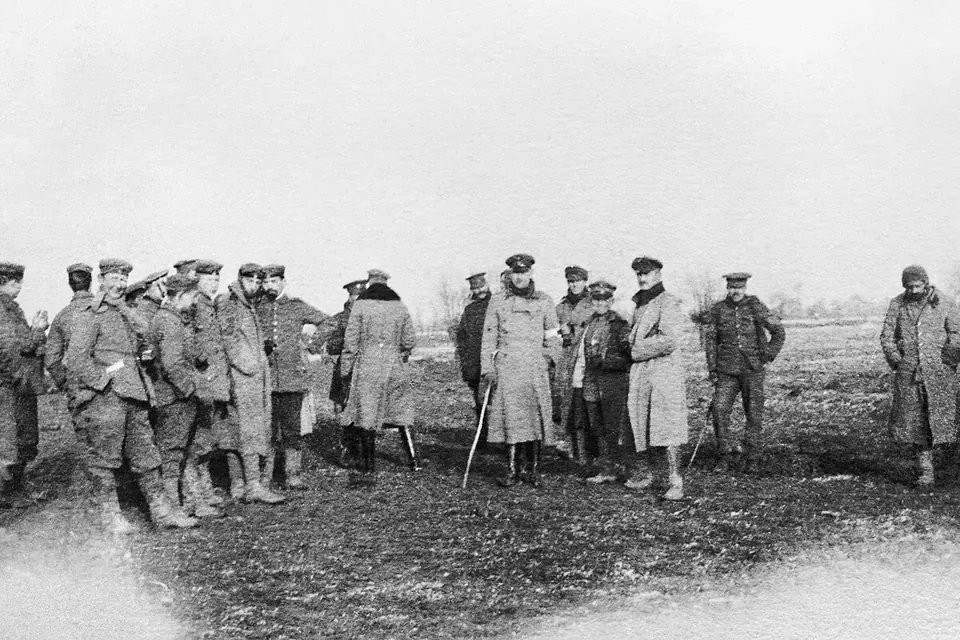
Over Christmas 1914, along stretches of the Western Front, British and German soldiers stopped fighting on their own initiative. They sang carols across the lines, met in no man's land, exchanged food and souvenirs, buried their dead together and, in some places, kicked a football about. It was unofficial, uneven and short-lived, and it was never repeated on the same scale.
The setting
By December 1914 the war of movement that had begun in August had ended in deadlock. After the Battle of the Marne and the First Battle of Ypres, both sides had dug trench lines running from the Belgian coast to Switzerland. In places the trenches were only a few dozen metres apart, close enough for soldiers to hear each other talk. Winter rain flooded the trenches, and the bodies of men killed in earlier attacks lay unburied between the lines.
On 7 December Pope Benedict XV appealed for a truce over Christmas, asking that "the guns may fall silent at least upon the night the angels sang". The governments and commanders of the warring powers did not agree to any official ceasefire.
What happened
On Christmas Eve, in sectors held by British and German troops, especially in Flanders south of Ypres and in northern France, German soldiers placed small Christmas trees with candles on their parapets and began singing carols. British troops answered with their own songs. Shouted conversations led to agreements not to shoot, and on Christmas Day men climbed out of the trenches to meet in the open.
Letters and diaries describe men shaking hands, swapping cigarettes, chocolate, plum puddings, buttons and cap badges, and having photographs taken together. One of the most practical results was the chance to recover and bury the dead lying in no man's land; in several places joint burial services were held. The truce was strongest on Christmas Day itself, but in some sectors it lasted until Boxing Day or even into the new year, while in others there was no truce at all and fighting continued. Participation is usually estimated at around 100,000 men, overwhelmingly British and German; there were also scattered reports of truces involving French and Belgian troops.
Was there really a football match?
The football story is the best-known part of the truce and also the most argued over. A letter from a British army doctor published in The Times on 1 January 1915 mentioned a match against the Saxons, and several other soldiers' letters refer to games. Historians have reached different conclusions:
- some researchers concluded that organised matches were unlikely, given the shell-torn, frozen or waterlogged ground, and that many reports were second-hand;
- others have found enough first-hand mentions to conclude that informal kick-abouts took place in several locations, even if there is little evidence of a structured game with teams, a referee and a final score.
The safest summary is that impromptu football almost certainly happened in a few places, and that the popular image of a single, organised international match owes much to later retellings.
Reaction from above
Senior commanders on both sides disapproved. Fraternisation threatened discipline and the willingness to fight. General Sir Horace Smith-Dorrien, commanding the British II Corps, had already forbidden friendly contact with the enemy before Christmas, and German orders against fraternisation followed. News of the truce reached the British public through soldiers' letters printed in newspapers, and photographs appeared in the popular press in early January 1915. In France, press censorship kept the story much quieter.
Why it was not repeated
At Christmas 1915, commanders took steps to prevent another truce, ordering artillery fire and raids over the holiday. A few small, brief truces still occurred, but nothing on the scale of 1914. By then the war had become far more bitter: 1915 brought the first large-scale use of chlorine gas on the Western Front, at Ypres in April, and enormous casualties, and the professional pre-war armies had been heavily replaced by new recruits. Short local truces to collect the wounded or bury the dead did continue at times throughout the war, both on the Western Front and elsewhere, such as the agreed nine-hour truce for burying the dead at Gallipoli in May 1915.
Remembering the truce
The truce has become one of the most retold episodes of the First World War, a reminder of shared humanity in the middle of industrialised slaughter. For its centenary in 2014, memorials were unveiled, among them a football-themed memorial at the National Memorial Arboretum in Staffordshire, England, and matches and commemorations were held in Flanders near Ploegsteert, close to where some of the meetings took place. Historians caution against sentimentalising it: the soldiers who met on Christmas Day mostly went back to fighting afterwards, and many of them did not survive the war.
Quick quiz: the Christmas truce
Sources
- Imperial War Museums, The real story of the Christmas truce.
- Brown, M. and Seaton, S. (1984). Christmas Truce: The Western Front, December 1914. Leo Cooper / Secker & Warburg.
- Weintraub, S. (2001). Silent Night: The Story of the World War I Christmas Truce. Free Press.
- Wikipedia, Christmas truce (evidence debate and commemorations, consulted October 2026).
 People & Customs
How did Halloween start?
Samhain, All Hallows' Eve, guising and turnip lanterns: where the holiday comes from.
 History
Holy Roman Emperors
From Charlemagne to Francis II: how emperors were elected and crowned, 800 to 1806.
 History
The largest empires in history
British, Mongol, Russian and the rest, by peak land area, and why the ranking is fuzzy.