The Largest Empires in History, by Peak Land Area
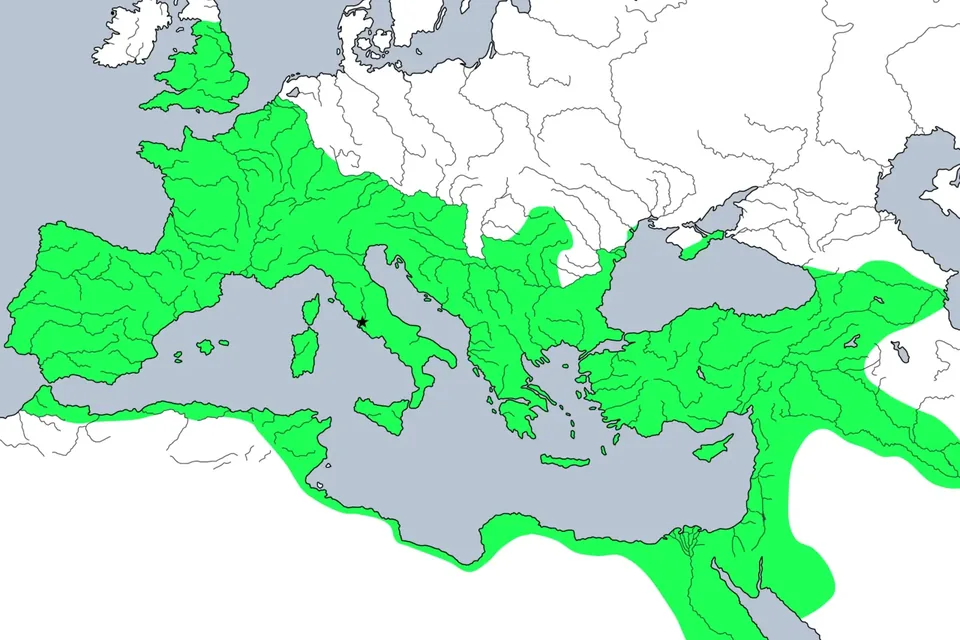
By land area at its peak, the largest empire in history was the British Empire, at roughly 35.5 million square kilometres around 1920. The Mongol Empire, at about 24 million km² in the late 13th century, was the largest contiguous land empire. Both figures are scholarly estimates, and the further back you go, the rougher they become.
Where the numbers come from
Almost every ranking of empires you will meet, from encyclopaedia lists to quiz books, traces back to a small number of academic compilations. The most important are the work of the political scientist Rein Taagepera, who in a series of papers (1978, 1979 and 1997) estimated the territory of large states century by century, and a 2006 paper by Peter Turchin, Jonathan Adams and Thomas Hall that compiled peak areas for about 60 historical empires to study why they tended to stretch east–west.
Taagepera measured areas from historical atlases, typically counting land over which a state exerted at least some control or tribute. That choice matters. A steppe empire that collected tribute from loosely held regions looks much bigger by this measure than by a stricter standard of direct administration. Colonial empires raise another question: does a protectorate count, or a claimed but unexplored interior? The figures below are therefore best read as "of the order of", not as exact surveys.
The largest empires at their peak
The table lists commonly cited peak areas, rounded as in the sources. Where both Taagepera and Turchin, Adams and Hall give a figure, they broadly agree.
| Empire | Peak area (million km²) | Approx. year of peak | Main source of estimate |
|---|---|---|---|
| British Empire | 35.5 | 1920 | Taagepera 1997 |
| Mongol Empire | 24.0 | c. 1270–1309 | Taagepera 1997; Turchin et al. 2006 |
| Russian Empire | 22.8 | 1895 | Taagepera 1997; Turchin et al. 2006 |
| Qing dynasty (China) | 14.7 | 1790 | Taagepera 1997; Turchin et al. 2006 |
| Spanish Empire | 13.7 | 1810 | Taagepera 1997 |
| Second French colonial empire | 11.5 | 1920 | Taagepera 1997 |
| Abbasid Caliphate | 11.1 | 750 | Taagepera 1997 |
| Umayyad Caliphate | 11.1 | 720 | Taagepera 1997 |
| Yuan dynasty | 11.0 | 1310 | Taagepera 1997 |
| Xiongnu | 9.0 | 176 BC | Taagepera 1979; Turchin et al. 2006 |
| Ming dynasty | 6.5 | 1450 | Taagepera 1997; Turchin et al. 2006 |
| Rashidun Caliphate | 6.4 | 655 | Taagepera 1997 |
| Achaemenid Persian Empire | 5.5 | 500 BC | Taagepera 1979; Turchin et al. 2006 |
| Tang dynasty | 5.4 | 715 | Taagepera 1997; Turchin et al. 2006 |
| Macedonian Empire (Alexander) | 5.2 | 323 BC | Taagepera 1979; Turchin et al. 2006 |
| Ottoman Empire | 5.2 | 1683 | Taagepera 1997; Turchin et al. 2006 |
| Roman Empire | 5.0 | 117 | Taagepera 1979; Turchin et al. 2006 |
For scale: Earth's land surface is about 149 million km², or roughly 135 million km² if Antarctica is left out. On the second basis, the British Empire's 35.5 million km² works out at about a quarter of the world's land.
Notes on the top of the list
British Empire
The British peak is usually dated to just after the First World War, when mandates over former Ottoman and German territories were added to the dominions, colonies and protectorates already held. The figure includes self-governing dominions such as Canada and Australia, which accounts for a large share of the area. The peak was brief in historical terms: the dominions were already largely self-governing, and the empire contracted rapidly after the Second World War as colonies became independent states.
Mongol Empire
Founded by Chinggis (Genghis) Khan in 1206, the Mongol Empire expanded across Eurasia within two generations. By the later 13th century it had split into four successor states (the Yuan in China, the Ilkhanate in Persia, the Chagatai Khanate in Central Asia and the Golden Horde, or Jochi Ulus, on the western steppe). That is why its peak is given as a range: some estimates treat the successor khanates together, others measure the unified state before the split. Either way it remains the largest empire whose territory was one continuous block of land.
Russian Empire
The Russian Empire grew overland, eastward across Siberia to the Pacific and south into Central Asia and the Caucasus. Its late-19th-century extent of about 22.8 million km² is slightly larger than the later Soviet Union's roughly 22.4 million km², mainly because the empire included the Grand Duchy of Finland and the Polish lands it ruled, which the Soviet state did not keep. Alaska, sold to the United States in 1867, was already gone by the 1895 benchmark.
Why rankings differ from list to list
- Peak versus average. An empire's maximum extent may have lasted only a few years. Taagepera also studied duration; some empires that rank modestly by peak area held their land for far longer.
- Control versus claim. Spain claimed huge areas of the Americas that it never administered. Some compilations count claims, others do not.
- Which state is "the" empire. Is the Yuan dynasty part of the Mongol Empire or a separate state? Are the Eastern and Western Han one entry or two? Different lists split and lump differently.
- Population is a different ranking. Measured by share of the world's people, the order changes again; large, thinly populated territories in Siberia or Canada count for much less.
How to use these figures: quote them with "about" or "roughly", name the source ("according to Taagepera's estimates"), and avoid ranking empires that are within a few hundred thousand km² of each other. Differences that small are inside the margin of error.
Quick quiz: empires
Sources
- Taagepera, R. (1997). "Expansion and Contraction Patterns of Large Polities: Context for Russia." International Studies Quarterly 41(3): 475–504. doi:10.1111/0020-8833.00053
- Taagepera, R. (1979). "Size and Duration of Empires: Growth-Decline Curves, 600 B.C. to 600 A.D." Social Science History 3(3/4): 115–138.
- Turchin, P., Adams, J. M. and Hall, T. D. (2006). "East-West Orientation of Historical Empires and Modern States." Journal of World-Systems Research 12(2): 219–229. doi:10.5195/jwsr.2006.369
- Wikipedia, List of largest empires (compilation of the above estimates, consulted October 2026).
- Encyclopaedia Britannica, Mongol empire.
 History
Holy Roman Emperors
From Charlemagne to Francis II: how emperors were elected and crowned, 800 to 1806.
 Geography
The longest rivers in Africa
The Nile, Congo, Niger, Zambezi and the rest of the top ten, and why lengths vary.
 History
The Christmas truce of 1914
What really happened on the Western Front at Christmas 1914, football matches included.