The Giant Asian Hornet (Northern Giant Hornet): Facts and Myths
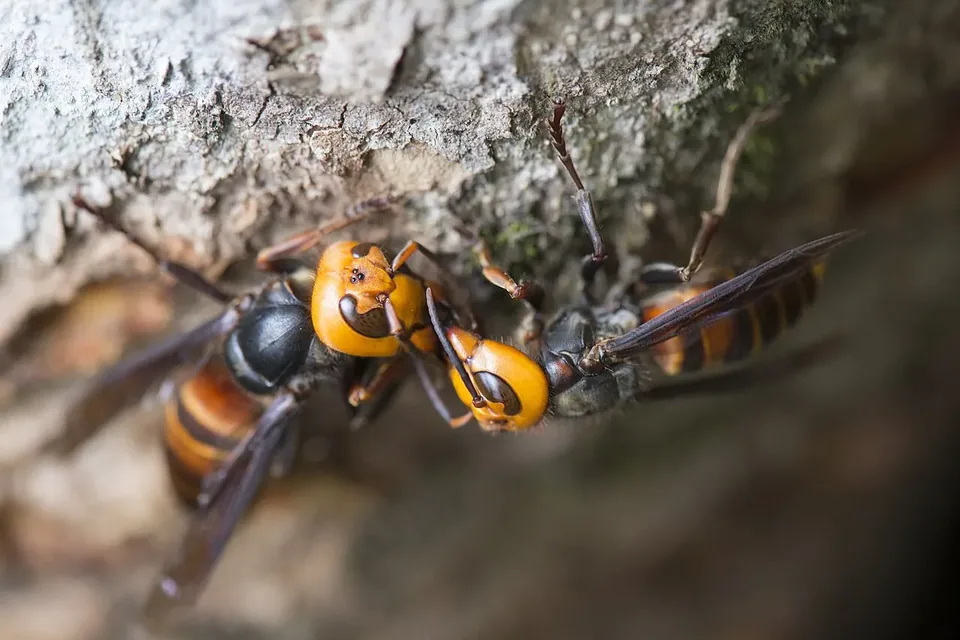
The giant Asian hornet, Vespa mandarinia, is the largest hornet in the world: queens can exceed 5 cm in length. Native to East and South Asia, it became briefly notorious in 2020 as the "murder hornet" after it was found in the Pacific Northwest. Since 2022 its recommended English name in North America has been the northern giant hornet.
Names
The species was described by the British entomologist Frederick Smith in 1852. Older books split it into several subspecies, but a 2020 taxonomic revision removed those ranks; names such as japonica now describe colour forms rather than formal subspecies. In 2022 the Entomological Society of America adopted "northern giant hornet" as the common name, replacing "Asian giant hornet" as part of an effort to avoid geographic and ethnic labels in insect names. The tabloid label "murder hornet" was never a scientific name.
How big is it?
- Queens: can be more than 50 mm (2 in) long.
- Workers: about 35–40 mm.
- Males (drones): up to about 38 mm, and like all male wasps, they have no sting.
- Wingspan: up to about 75 mm (3 in).
- Sting: about 6 mm long, long enough to penetrate ordinary beekeeping clothing.
The head is a distinctive orange-yellow, the eyes and ocelli dark, and the abdomen banded in dark brown and yellow-orange. Several native insects are regularly mistaken for it, which is why agencies asked the public to send photos rather than rely on size alone: in North America, the European hornet, the bald-faced hornet, cicada killer wasps and some horntails were the usual false alarms.
Where it lives
The native range covers temperate and tropical East Asia and parts of South and Southeast Asia: Japan, the Korean Peninsula, China, Taiwan and the Russian Far East, and into India, Nepal, Sri Lanka and mainland Southeast Asia. It nests mostly underground, often in abandoned rodent burrows or among tree roots, though one nest found in Washington State in 2020 was inside a hollow tree.
Life cycle
A colony is founded in spring by a single mated queen, who survived the winter on her own. She raises the first workers herself; from then on the workers forage and expand the nest while the queen lays eggs. In late summer and autumn the colony produces new queens and males, which mate. The old colony dies off in winter and only the newly mated queens overwinter, which is why spring trapping of queens and autumn destruction of nests are the two key moments in any control effort.
Hunting honeybees
Northern giant hornets prey on many insects, but their most dramatic behaviour is the mass attack on honeybee colonies in late summer and autumn, when the hornet colony needs protein for its developing queens. A scout marks a hive with a pheromone, and nestmates arrive to join the raid. In what researchers call the slaughter phase, hornets kill adult bees by decapitating them; a small group of hornets can destroy a colony of tens of thousands of European honeybees in a few hours. They then occupy the hive and carry the bee larvae and pupae back to feed their own young.
How Japanese honeybees fight back
The European honeybee (Apis mellifera), introduced to Asia by beekeepers, has little defence. The native Japanese honeybee (Apis cerana japonica) has evolved one: when a scout hornet enters, hundreds of workers engulf it in a tight ball and vibrate their flight muscles. The temperature inside the ball rises to about 46 °C, and carbon dioxide builds up. The bees can tolerate these conditions; the hornet cannot, and dies. Research by Masato Ono and colleagues, published in Nature in 1995, first described this "heat-balling" defence in detail.
Is it dangerous to people?
The hornet is not aggressive towards people away from its nest, but it defends the nest vigorously, and its sting is very painful. Its venom contains a neurotoxin, mandaratoxin, along with other compounds that damage tissue. Individually its venom is not the most toxic among wasps by weight; the danger comes from the large dose delivered by each sting and from multiple stings. Deaths occur in Asia every year, mostly from multiple stings or allergic reactions; health authorities advise anyone stung several times, or showing signs of an allergic reaction, to seek emergency care.
The North American episode
The species was first confirmed in North America in August 2019, near Nanaimo on Vancouver Island, British Columbia, where a nest was destroyed. Later in 2019 specimens were found near Blaine, Washington. The Washington State Department of Agriculture (WSDA), working with the U.S. Department of Agriculture and Canadian authorities, set traps, tagged live hornets with tiny radio trackers to follow them home, and in October 2020 destroyed the first nest found in the United States, in a tree near Blaine. Further nests were destroyed in 2021. After no confirmed detections for three consecutive years, WSDA and the USDA announced on 18 December 2024 that the northern giant hornet had been eradicated from Washington and the United States. Officials noted that about half of the confirmed detections had come from members of the public.
Different species, similar headlines: the yellow-legged hornet (Vespa velutina), which has spread across much of Europe since it was first detected in France in 2004, and was found in Georgia (USA) in 2023, is often called the "Asian hornet" too. It is smaller and is a separate species.
Quick quiz: giant hornets
Sources
- Washington State Department of Agriculture, Hornets (northern giant hornet programme and eradication announcement).
- PCT Online, WSDA, USDA announce eradication of northern giant hornet from US (December 2024).
- Entomological Society of America, Better Common Names Project (2022 adoption of "northern giant hornet").
- Ono, M., Igarashi, T., Ohno, E. and Sasaki, M. (1995). "Unusual thermal defence by a honeybee against mass attack by hornets." Nature 377: 334–336. doi:10.1038/377334a0
- Wikipedia, Asian giant hornet (measurements and timeline, consulted October 2026).
 Nature
Hairless dog breeds
Xolo, Chinese Crested, Peruvian and American Hairless, and the genetics behind bare skin.
 Geography
The largest lakes in the world
Caspian, Superior, Victoria and Baikal, ranked by area, depth and volume.
 Human Body
Bones of the body
Why adults have 206 bones and babies more, and how they split across the skeleton.