Why Is Bonfire Night on 5 November? The Gunpowder Plot, Guy Fawkes and the Guy
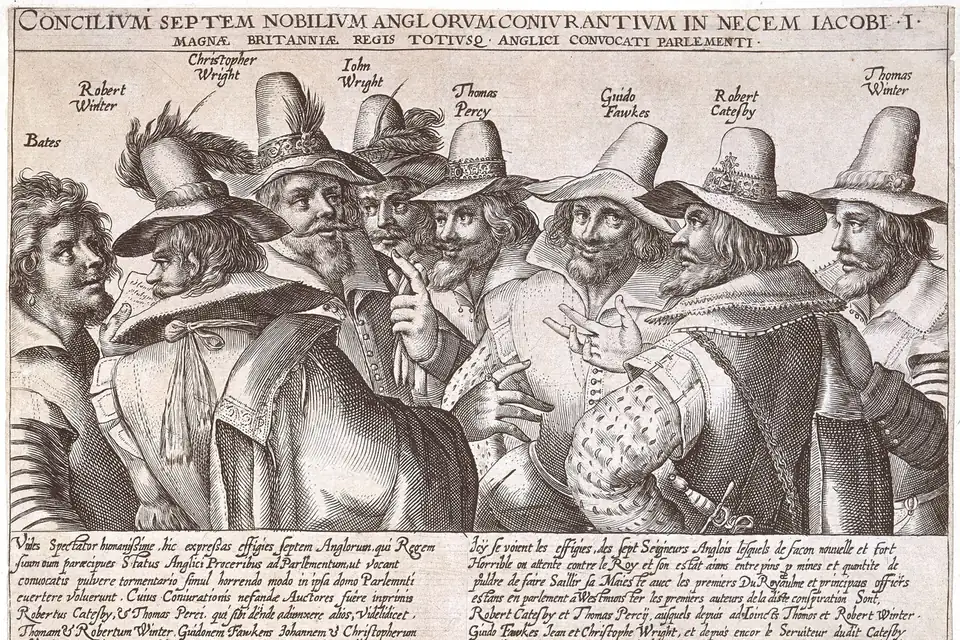
Every year on 5 November, towns across Britain light bonfires, set off fireworks and, in some places, burn a stuffed figure called a guy. The occasion is a plot that failed: a scheme to blow up the King and Parliament in 1605 with gunpowder hidden under the House of Lords. The man most people associate with it, Guy Fawkes, was not its leader. He was simply the one caught standing next to the barrels.
What the plotters wanted
When James I succeeded Elizabeth I in 1603, many English Catholics hoped that the laws against their faith would be relaxed. Catholics faced heavy fines for not attending Protestant services, and Catholic priests were outlawed. James kept those laws. A small group of Catholic gentlemen, led by Robert Catesby, decided that only killing the King would change things.
Their plan was to strike at the State Opening of Parliament, when the King, his leading ministers, the Lords and the Commons would all be in the Palace of Westminster. According to The National Archives, the plotters intended to follow the explosion with a rising in the Midlands and to seize the King's nine-year-old daughter, Princess Elizabeth, from Coombe Abbey, so that she could be placed on the throne as a figurehead.
The conspirators rented an undercroft, a ground-level storeroom, directly beneath the chamber of the House of Lords, and filled it with barrels of gunpowder hidden under firewood. The opening of Parliament was postponed several times, partly because of plague, and was finally set for 5 November 1605.
The letter and the midnight search
On 26 October 1605, a servant of the Catholic peer Lord Monteagle was handed a letter by an unknown man. Unsigned, it urged Monteagle to stay away from the opening of Parliament, warning that those present "shall receive a terrible blow this parliament and yet they shall not see who hurts them". Monteagle took it straight to the government. Who wrote it has never been established, although historians have suspected several people, including one of the plotters' relatives.
The conspirators learned that the letter had been passed on but decided to go ahead. Around midnight on 4 November, a search party led by Sir Thomas Knyvet went through the rooms beneath Parliament. There they found a man guarding a room full of firewood, and under it, according to The National Archives, 36 barrels of gunpowder. He gave his name as John Johnson. He was carrying the means to light a fuse.
"Johnson" was Guy Fawkes, a soldier born in York in 1570 who had spent years fighting for Spain in the Low Countries, where he called himself Guido. His experience with gunpowder was why the others had recruited him. He was taken to the Tower of London for questioning. The King authorised torture in writing, instructing that the "gentler tortures" be used first, and over the following days Fawkes gave up his real name and those of his companions.
Would it have worked?
When the barrels were moved to the Tower, the gunpowder was described as decayed, and people have argued ever since that it might not have exploded. A television experiment made for ITV in 2005 tested that idea by detonating a similar quantity of deliberately degraded powder under a replica chamber. The blast was large enough to destroy it, suggesting that anyone in the House of Lords that morning would very probably have been killed.
Some writers, then and now, have also asked whether the government knew of the plot earlier than it admitted and let it ripen. There is no proof of that, but the question shows how politically useful the discovery was to James and his chief minister, Robert Cecil.
What happened to the plotters
Catesby and several others fled to the Midlands. On 8 November, at Holbeche House on the Staffordshire border, the Sheriff of Worcestershire's men caught up with them. Catesby and Thomas Percy were killed in the fighting, and others were wounded and captured. One more conspirator, Francis Tresham, died in the Tower before he could be tried.
The eight survivors, Fawkes among them, were tried in Westminster Hall in January 1606 and found guilty of high treason. Four were executed in St Paul's Churchyard on 30 January, and four, including Fawkes, on 31 January in Old Palace Yard at Westminster, within sight of the building they had meant to destroy. The sentence was hanging, drawing and quartering. Fawkes, weakened by his treatment in the Tower, either jumped or fell from the gallows and broke his neck, which spared him the rest of the punishment.
From thanksgiving to Bonfire Night
The celebrations began almost at once. Londoners lit bonfires on the night of 5 November 1605 to mark the King's escape, and in January 1606 Parliament passed the Observance of 5th November Act, which ordered an annual service of thanksgiving in every parish church. Church bells, sermons and bonfires became part of the day. The Act stayed in force until 1859.
For much of the seventeenth and eighteenth centuries the day had a sharp anti-Catholic edge, and the figure burned on the fire was often the Pope rather than Fawkes. The custom crossed the Atlantic: in colonial New England, "Pope's Day" processions on 5 November could turn into street fights, and in 1775 George Washington forbade his troops to observe it while the colonies were courting Catholic Canada as an ally.
Over time the effigy came to stand for Fawkes, and children carried home-made "guys" through the streets asking for "a penny for the guy" to buy fireworks. The word itself drifted: in the nineteenth century a "guy" meant a shabbily or oddly dressed person, and in the twentieth it became, first in American English, an ordinary word for any man. Most people who say "you guys" today have no idea they are naming a seventeenth-century conspirator.
The religious edge has faded almost everywhere. Lewes, in East Sussex, keeps the most elaborate celebrations, with several bonfire societies parading through the town; they also remember seventeen Protestant martyrs burned there in the 1550s, under Mary I. Like Halloween, which falls a few days earlier and also features fires and masks, Bonfire Night now owes more to habit and fireworks than to its origins. And like the silence of Armistice Day a week later, it is a November date that commemorates a single, precisely remembered moment.
The search that still happens
One tradition goes straight back to the plot. Before each State Opening of Parliament, the Yeomen of the Guard, the monarch's bodyguard in their red Tudor uniforms, search the cellars of the Palace of Westminster with lanterns. The ceremonial search has been carried out since 1678, when another alleged Catholic conspiracy, the Popish Plot, revived fears of an attack on Parliament. Today it sits alongside modern security checks rather than replacing them, but it remains a reminder of a November night when a search really did find something.
Fawkes is often remembered as the plot's mastermind, which he was not. As The National Archives notes, generations of children burning his effigy have kept that misunderstanding alive. The rhyme does at least get the date right: "Remember, remember the fifth of November, gunpowder, treason and plot."
Quick quiz: the Gunpowder Plot
Sources
- The National Archives (UK). The Gunpowder Plot, education resource with the Monteagle letter (SP 14/216/2) and the examination of "John Johnson" (SP 14/216/6), at nationalarchives.gov.uk.
- Fraser, A. (1996). The Gunpowder Plot: Terror and Faith in 1605. Weidenfeld & Nicolson.
- Sharpe, J. (2005). Remember, Remember the Fifth of November: Guy Fawkes and the Gunpowder Plot. Profile Books.
- UK Parliament, Living Heritage: The Gunpowder Plot of 1605 and the ceremonial search before the State Opening.
 History
Armistice Day, 11 November
The eleventh hour of the eleventh day, the two minutes' silence and the poppy: where each tradition comes from.
 People & Customs
How did Halloween start?
Samhain, All Hallows' Eve, guising and turnip lanterns: where the holiday comes from.
 History
The Christmas truce of 1914
What really happened on the Western Front at Christmas 1914, football matches included.