The Seven Summits: The Highest Mountain on Each Continent
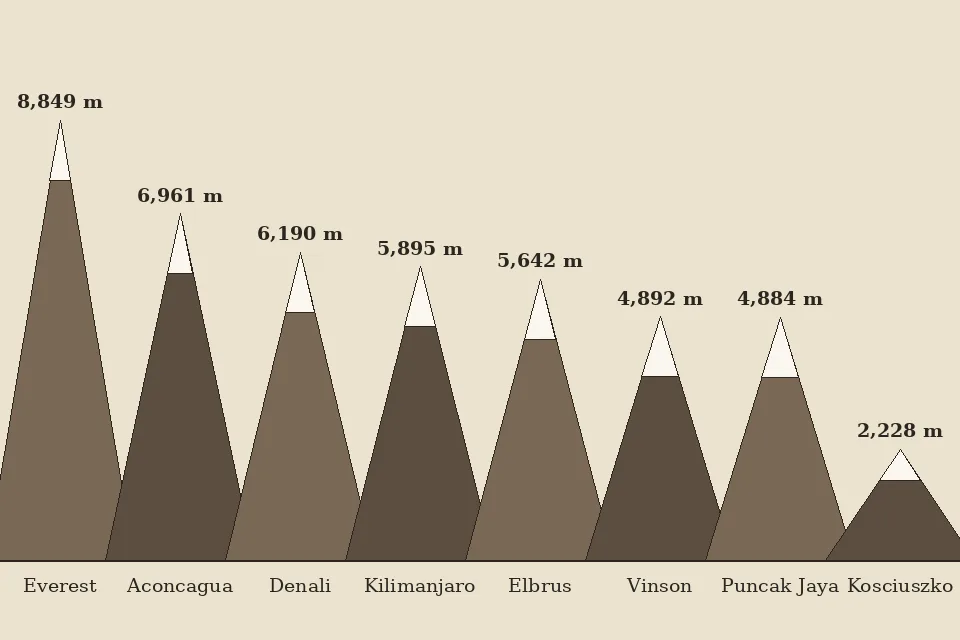
The Seven Summits are the highest mountains on each of the seven continents: Everest in Asia, Aconcagua in South America, Denali in North America, Kilimanjaro in Africa, Elbrus in Europe, Vinson in Antarctica, and, for Australia, either Puncak Jaya or Kosciuszko. That last "either" is the interesting part: the list depends on where you draw the edges of continents, and mountaineers have argued about it since the 1980s.
The highest peak on each continent
Heights below are the figures most reference works use, with the survey behind them where one is well documented. Mountains with an ice cap change height slightly from year to year, so the last metre is always a snapshot.
| Continent | Mountain | Height (m) | Height (ft) | Country | First ascent |
|---|---|---|---|---|---|
| Asia | Everest | 8,848.86 | 29,032 | Nepal / China | 1953 |
| South America | Aconcagua | 6,961 | 22,838 | Argentina | 1897 |
| North America | Denali (Mount McKinley) | 6,190 | 20,310 | United States | 1913 |
| Africa | Kilimanjaro (Kibo) | 5,895 | 19,341 | Tanzania | 1889 |
| Europe | Elbrus | 5,642 | 18,510 | Russia | 1874 (west summit) |
| Antarctica | Vinson | 4,892 | 16,050 | none (Antarctica) | 1966 |
| Australia (continent) | Puncak Jaya (Carstensz Pyramid) | 4,884 | 16,024 | Indonesia | 1962 |
| Australia (mainland) | Kosciuszko | 2,228 | 7,310 | Australia | first recorded 1840 |
The table has eight rows for seven continents because the last two compete for the same slot. Climbers who want to be sure of both simply climb both, which is why you will sometimes see the phrase "Eight Summits".
How the heights were measured
Everest: 8,848.86 m
Nepal and China announced this figure jointly on 8 December 2020, after survey teams from both countries measured the summit, the Chinese team in May 2020 and the Nepalese team in 2019. It is the height of the snow and ice on top, not of the rock beneath. For decades the two countries had used different figures: China's 2005 survey gave 8,844.43 m for the rock, while Nepal used 8,848 m for the snow surface, a disagreement they settled in 2010 by accepting both as describing different things. Everest stands inside Sagarmatha National Park, a UNESCO World Heritage Site since 1979. Edmund Hillary and Tenzing Norgay made the first confirmed ascent on 29 May 1953.
Denali: 20,310 ft
A survey team placed GPS receivers on the summit in June 2015, and the U.S. Geological Survey announced the result that September: 20,310 ft (6,190 m), ten feet lower than the 20,320 ft found by photogrammetry in 1952. The mountain is also the best example of how names change. The Koyukon name Denali was adopted by the State of Alaska in 1975 and by the federal government in August 2015; in January 2025 the U.S. Department of the Interior restored Mount McKinley as the federal name. The surrounding park is still Denali National Park and Preserve, and the National Park Service's mountaineering page now refers to climbs of "Mount McKinley".
Vinson: 4,892 m
Antarctica's highest peak was only climbed in 1966, by an American team led by Nicholas Clinch. Its current height comes from a GPS survey made in 2004 by a team from the Omega Foundation, which corrected older values derived from maps.
Kilimanjaro: 5,895 m
Kilimanjaro is a volcano rather than part of a mountain range, and its highest point, Uhuru Peak on the Kibo cone, is generally given as 5,895 m. It is the centre of Kilimanjaro National Park, also a World Heritage Site. Hans Meyer and Ludwig Purtscheller reached the top in 1889.
Two lists: Bass and Messner
The idea of collecting every continental high point became a public challenge in the early 1980s. The American businessman Richard Bass and his partner Frank Wells set out to climb the highest peak on each continent, and Bass finished on 30 April 1985 by reaching the top of Everest. Bass counted Kosciuszko for Australia, a walk of a few hours from the nearest car park.
The Italian climber Reinhold Messner argued for a different choice. Geologically, the Australian continent includes New Guinea, which sits on the same continental shelf, so its highest point is Puncak Jaya (also called Carstensz Pyramid) in the Indonesian province of Central Papua: a technical rock climb reached through jungle. The Canadian Patrick Morrow was the first to complete this version, finishing on Puncak Jaya on 7 May 1986; he was also the first to have climbed all eight peaks on both lists.
A third candidate sometimes appears. Some sources treat Indonesia as part of Asia for political reasons and give Mount Wilhelm in Papua New Guinea (about 4,509 m) as Oceania's highest point. Access matters too: Puncak Jaya has been hard to reach for long periods because of security restrictions in the region.
Europe's problem: Elbrus or Mont Blanc?
Both main lists use Elbrus, in the Caucasus, for Europe. Whether Elbrus is in Europe at all depends on where you put the boundary between Europe and Asia between the Black Sea and the Caspian. If the boundary follows the crest of the Greater Caucasus, Elbrus lies just on the European side; if it follows the Kuma–Manych Depression further north, the whole Caucasus is in Asia, and Europe's highest mountain becomes Mont Blanc on the French–Italian border. Mont Blanc's ice-capped summit has been measured every two years since 2003 and moves by a metre or two between surveys, staying a little above 4,800 m.
This is the same kind of definitional choice that reshuffles other "biggest" lists. Whether the Caspian counts as a lake changes the answer in our page on the largest lakes in the world, and where a river's source and mouth are placed explains why the lengths of Africa's longest rivers vary from one atlas to the next.
Highest is not the same as tallest
"Highest" means highest above sea level, and by that measure Everest wins. Two other measures give different answers:
- Base to peak. Mauna Kea in Hawaii reaches only 4,207 m above sea level, but it rises from the floor of the Pacific, and measured from its base it is roughly 10,200 m tall, more than Everest. Denali also has one of the greatest rises above its surroundings of any mountain on land, about 5,500 m, because it starts from a low plain, while Everest starts from the high Tibetan Plateau.
- Distance from the centre of the Earth. The Earth bulges at the Equator, so a summit near the Equator sits farther from the planet's centre. By this measure the winner is Chimborazo in Ecuador (6,263 m above sea level), not Everest.
For quizzes, the safest facts are the six peaks no list disputes (Everest, Aconcagua, Denali, Kilimanjaro, Vinson and, on both main lists, Elbrus) and the two-way choice for Australia: Kosciuszko on the Bass list, Puncak Jaya on the Messner list.
Quick quiz: the Seven Summits
Sources
- Survey Department of Nepal and Ministry of Natural Resources of China, joint announcement of the height of Mount Everest, 8 December 2020.
- U.S. Geological Survey, New Elevation for Nation's Highest Peak (press release, 2 September 2015).
- U.S. Department of the Interior, announcement restoring the name Mount McKinley (24 January 2025); National Park Service, Denali National Park and Preserve, mountaineering information (consulted October 2026).
- UNESCO World Heritage Centre, Sagarmatha National Park (inscribed 1979) and Kilimanjaro National Park (inscribed 1987).
- Bass, D., Wells, F. and Ridgeway, R. (1986). Seven Summits. Warner Books.
- Morrow, P. (1986). Beyond Everest: Quest for the Seven Summits. Camden House.
- Omega Foundation (Damien Gildea, Rodrigo Fica and Camilo Rada), GPS survey of Mount Vinson, 2004.
- Wikipedia, Seven Summits; Mont Blanc (survey history); Mauna Kea; Chimborazo (consulted October 2026).
 Geography
The longest rivers in Africa
The Nile, Congo, Niger, Zambezi and the rest of the top ten, and why lengths vary.
 Geography
The largest lakes in the world
Caspian, Superior, Victoria and Baikal, ranked by area, depth and volume.
 History
The largest empires in history
British, Mongol, Russian and the rest, by peak land area, and why the ranking is fuzzy.