Why Did the Roman Empire Fall? 476, the Debate and the Half That Survived
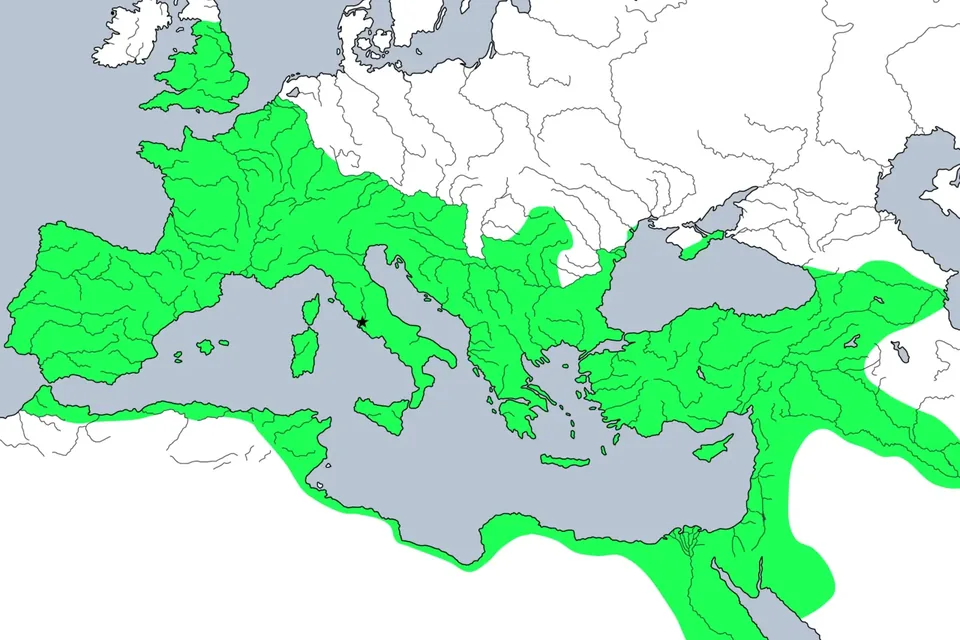
Ask when the Roman Empire fell and the usual answer is AD 476, the year a Germanic general deposed a teenage emperor in Italy. That date is real, but it marks the end of a long process rather than a sudden collapse, it concerns only the western half of the empire, and historians still disagree about why it happened at all. Even the word "fall" is contested.
What happened in 476
In 475 a general named Orestes, who had once served at the court of Attila the Hun, drove out the western emperor Julius Nepos and placed his own young son, Romulus, on the throne. The boy became known as Romulus Augustulus, "little Augustus". The following year, soldiers in Italy, many of them recruited from Germanic peoples, demanded land; when Orestes refused, they rallied to one of their officers, Odoacer. Orestes was killed and, in 476, Odoacer deposed Romulus Augustulus but spared his life and sent him to live in Campania.
Odoacer did not proclaim himself emperor. He sent the imperial regalia to Constantinople and ruled Italy as king, formally recognising the eastern emperor Zeno. In legal terms, the western throne was simply left empty; Julius Nepos, still alive in Dalmatia, was recognised by Zeno as western emperor until he was murdered in 480. Few people at the time seem to have seen 476 as the end of an era. The date became symbolic much later.
A long decline, not a single blow
By 476 the western empire controlled little beyond Italy. The events that hollowed it out stretch back more than a century:
- The crisis of the third century (roughly 235 to 284): dozens of short-lived emperors, civil wars, invasions and a debased currency. The empire survived, but only after deep reforms.
- Diocletian and Constantine: Diocletian split imperial power between several rulers (the Tetrarchy, from 293) and reorganised the army and taxation. Constantine founded Constantinople, dedicated in 330, which became the centre of gravity of the eastern half.
- Adrianople, 378: Gothic forces destroyed a Roman army and killed the eastern emperor Valens, a defeat contemporaries saw as a disaster.
- The division of 395: on the death of Theodosius I the empire was shared between his sons, Arcadius in the east and Honorius in the west. It had been divided before, but this time the split proved permanent.
- The Rhine crossing: at the end of 406, Vandals, Alans and Suebi crossed the Rhine into Gaul, and the western government never fully regained control of the provinces beyond Italy.
- The sack of Rome, 410: Alaric's Visigoths plundered the city, the first time it had been taken by a foreign enemy in about 800 years.
- The loss of Africa, 439: the Vandals under Gaiseric took Carthage and the rich North African provinces, depriving the West of a major source of tax revenue and grain.
- Attila and after: a Roman and Gothic coalition fought Attila's army at the Catalaunian Plains in 451; the Vandals sacked Rome again in 455.
Why did it happen? The great debate
Few historical questions have produced as many answers. The German historian Alexander Demandt famously collected 210 factors that had been proposed by 1984, from lead poisoning to moral decay. Most modern explanations fall into a few families.
Internal weakness
Edward Gibbon, whose History of the Decline and Fall of the Roman Empire appeared between 1776 and 1789, blamed in part the loss of civic virtue and the influence of Christianity, a view few historians now accept in that form. Later explanations stressed civil wars and usurpations, which pulled armies away from the frontiers, a heavy tax burden, and an aristocracy in the West that grew rich while the state grew poor.
External pressure
Other historians emphasise the outside world. The arrival of the Huns in the late fourth century pushed Goths and other peoples into the empire, and later groups settled inside it as allies, as conquerors or as both. Peter Heather's The Fall of the Roman Empire (2005) is a well-known modern statement of this view: the empire was not rotten inside, but it faced larger and better organised neighbours than ever before.
Transformation, not fall
From the 1970s, historians of "late antiquity", following Peter Brown, argued that the period should be seen as a transformation in which Roman law, the Latin language, the Church and many institutions continued under new rulers. Bryan Ward-Perkins replied in The Fall of Rome and the End of Civilization (2005) with archaeological evidence of a real collapse in living standards in the West: simpler pottery, fewer coins, smaller buildings and even smaller cattle. Most historians today accept elements of both views, depending on the region and on what is being measured.
Environment and disease
More recent work has added climate change and epidemics to the picture, especially for later centuries, though how much weight they should carry remains debated.
The half that survived
The eastern Roman Empire, which later historians call the Byzantine Empire, never "fell" in 476. Its inhabitants went on calling themselves Romans. Under Justinian it reconquered North Africa in 533 to 534 and Italy after a long war that ended in the 550s. The empire shrank over the following centuries, but Constantinople held out until 29 May 1453, when it was taken by the Ottoman sultan Mehmed II. By that measure the Roman state lasted almost a thousand years after Romulus Augustulus.
Meanwhile, the idea of a Roman emperor in the West was revived in AD 800, when Pope Leo III crowned Charlemagne in Rome. That title eventually became the one carried by the Holy Roman Emperors until 1806. For how large the empire was at its peak compared with others, see the largest empires in history.
Quick quiz: the fall of Rome
Sources
- Gibbon, E. (1776–1789). The History of the Decline and Fall of the Roman Empire, full text at Project Gutenberg.
- Heather, P. (2005). The Fall of the Roman Empire: A New History. Macmillan.
- Ward-Perkins, B. (2005). The Fall of Rome and the End of Civilization. Oxford University Press.
- Brown, P. (1971). The World of Late Antiquity, AD 150–750. Thames & Hudson.
- Demandt, A. (1984). Der Fall Roms: Die Auflösung des römischen Reiches im Urteil der Nachwelt. C. H. Beck.
HistoryThe largest empires in history
British, Mongol, Russian and the rest, by peak land area, and why the ranking is fuzzy.
 History
Holy Roman Emperors
From Charlemagne to Francis II: how emperors were elected and crowned, 800 to 1806.
 History
The Christmas truce of 1914
What really happened on the Western Front at Christmas 1914, football matches included.