Why Is Thanksgiving on the Fourth Thursday of November? Plymouth, Lincoln and the Two-Thanksgiving Years
Most American holidays fall on a fixed date or on a Monday. Thanksgiving falls on the fourth Thursday of November, which in 2026 is 26 November. The rule looks arbitrary, and in a sense it is: it was settled by Congress in 1941, after two years in which the country could not agree on which Thursday to celebrate. The story behind it runs from a harvest meal in 1621 to a fight about the Christmas shopping season.
What happened at Plymouth in 1621
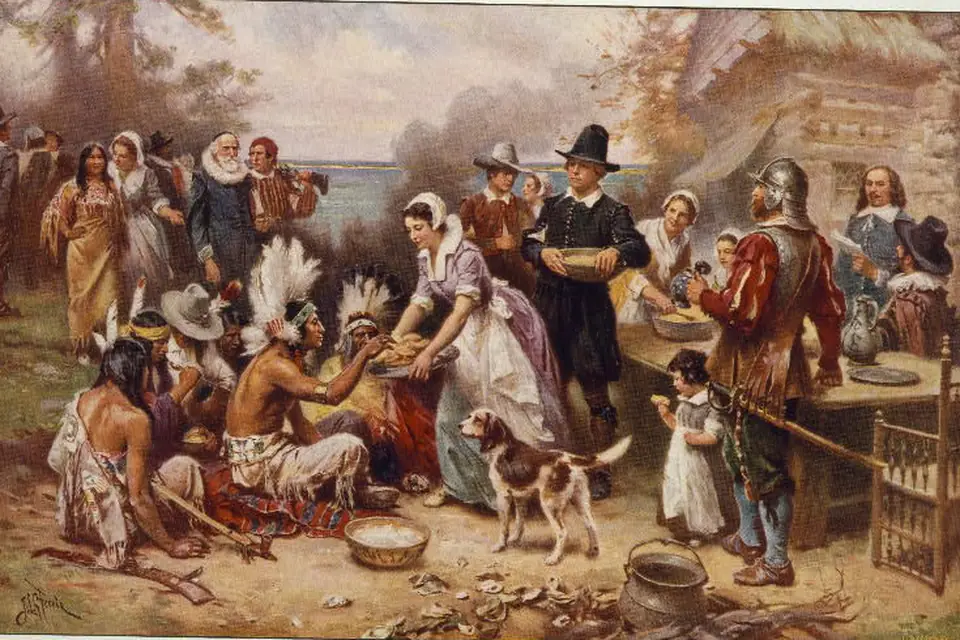
The meal now called the first Thanksgiving took place in the autumn of 1621 at Plymouth, in what is now Massachusetts, less than a year after the Mayflower passengers landed. Almost everything we know about it comes from a few lines in a letter by one of the colonists, Edward Winslow, printed in London in 1622 in the pamphlet known as Mourt's Relation.
Winslow writes that after the harvest was gathered, the governor sent four men out "fowling", so that the colonists might "rejoice together" after their labours. Many Wampanoag men then arrived with their leader, Massasoit, whom Winslow describes as coming with "some ninety men". They stayed three days, and the Wampanoag went out and killed five deer, which they gave to the governor, the captain and others. That is close to the full extent of the eyewitness record.
A few things follow from it. The menu certainly included wild fowl and venison; turkey is possible but not mentioned by name, and there is no record of pumpkin pie. The colonists themselves would not have called it a "thanksgiving": for them, a day of thanksgiving was a religious occasion of prayer, not a feast with games. And the presence of the Wampanoag was part of a recent alliance between Massasoit's people and the newcomers, not a simple invitation to dinner.
The 1621 meal was not called a thanksgiving at the time, and it was not repeated every year.
From scattered proclamations to a national day
For the next two centuries, thanksgiving days were declared irregularly, by colonies, then by states, and occasionally by the national government. George Washington proclaimed one for Thursday 26 November 1789, but it did not become an annual custom. By the nineteenth century, many states, especially in New England, held a Thanksgiving every autumn, each on a date chosen by its own governor.
The person who did most to change that was Sarah Josepha Hale, the long-serving editor of Godey's Lady's Book, one of the most widely read magazines in the country. From the 1840s she campaigned in editorials and letters for a single national Thanksgiving on the last Thursday of November, writing to governors and presidents for years. In September 1863 she wrote to Abraham Lincoln.
A few days later, on 3 October 1863, in the middle of the Civil War, Lincoln issued a proclamation inviting Americans to observe the last Thursday of November as "a day of Thanksgiving and Praise". From then on, every president issued a similar proclamation each year, and the last Thursday of November became the national custom.
1939: the year of two Thanksgivings
The custom held until 1939. That year, November had five Thursdays, and the last one fell on 30 November, the last day of the month. Retailers worried that such a late Thanksgiving would shorten the Christmas shopping season, which by tradition began after the holiday. Franklin D. Roosevelt responded by proclaiming Thanksgiving on the second-to-last Thursday instead, 23 November.
The change was announced late and was not binding on the states, which set their own holidays. According to the US National Archives, 32 states followed the president and 16 kept the last Thursday, so for two years the country celebrated two Thanksgivings. Critics nicknamed the early one "Franksgiving". Calendars printed in advance were wrong, school holidays and football fixtures clashed, and families split between the two dates.
1941: Congress fixes the fourth Thursday
Congress finally stepped in. On 6 October 1941, the House of Representatives passed a joint resolution naming the last Thursday of November as the legal Thanksgiving Day. The Senate amended it to say the fourth Thursday instead, so that in a month with five Thursdays the holiday would not fall on the very last days of November. The House agreed, and Roosevelt signed the resolution on 26 December 1941, less than three weeks after Pearl Harbor.
The fourth-Thursday rule means Thanksgiving can fall anywhere between 22 and 28 November. In years when November has five Thursdays, it is not the last Thursday of the month, which is exactly the situation that caused the quarrel in 1939.
The rest of the tradition
Many of the customs around the holiday are much younger than the date. New York's Macy's parade began in 1924, and the Detroit Lions have played on Thanksgiving Day since 1934, which is why American football is now as much a part of the day as the meal. The White House turkey "pardon", often described as an old tradition, was only made an annual ceremony under George H. W. Bush in 1989.
For some, the day has another meaning. Since 1970, Native American groups have gathered at Plymouth on Thanksgiving for a National Day of Mourning, to remember what the colonisation of New England cost the Wampanoag and other nations. And Canada has its own Thanksgiving, with a different history, on the second Monday of October.
The holiday sits in a busy season of autumn customs with surprising origins, from Halloween to Bonfire Night and Armistice Day. And if you have ever blamed the turkey for the sleepiness that follows the meal, our guide to how digestion works explains what a large meal does to the body.
Quick quiz: Thanksgiving
Sources
- US National Archives, Center for Legislative Archives. Congress Establishes Thanksgiving, at archives.gov.
- Abraham Lincoln, Proclamation of Thanksgiving, 3 October 1863, in Abraham Lincoln Online and Collected Works of Abraham Lincoln, vol. 6.
- Edward Winslow, letter of 11 December 1621, in A Relation or Journall of the Beginning and Proceedings of the English Plantation Setled at Plimoth ("Mourt's Relation"), London, 1622.
 History
The Gunpowder Plot and Bonfire Night
Thirty-six barrels, an anonymous letter, a man calling himself John Johnson, and four centuries of bonfires.
 People & Customs
How did Halloween start?
Samhain, All Hallows' Eve, guising and turnip lanterns: where the holiday comes from.
 History
Armistice Day, 11 November
The eleventh hour of the eleventh day, the two minutes' silence and the poppy: where each tradition comes from.